Monster Hunter Wilds Weakness Guide 2026: Complete Element & Hitzone Chart
Master monster weaknesses in MH Wilds with our comprehensive guide. Learn elemental matchups, hitzone values, status thresholds, and optimal damage strategies for every monster.
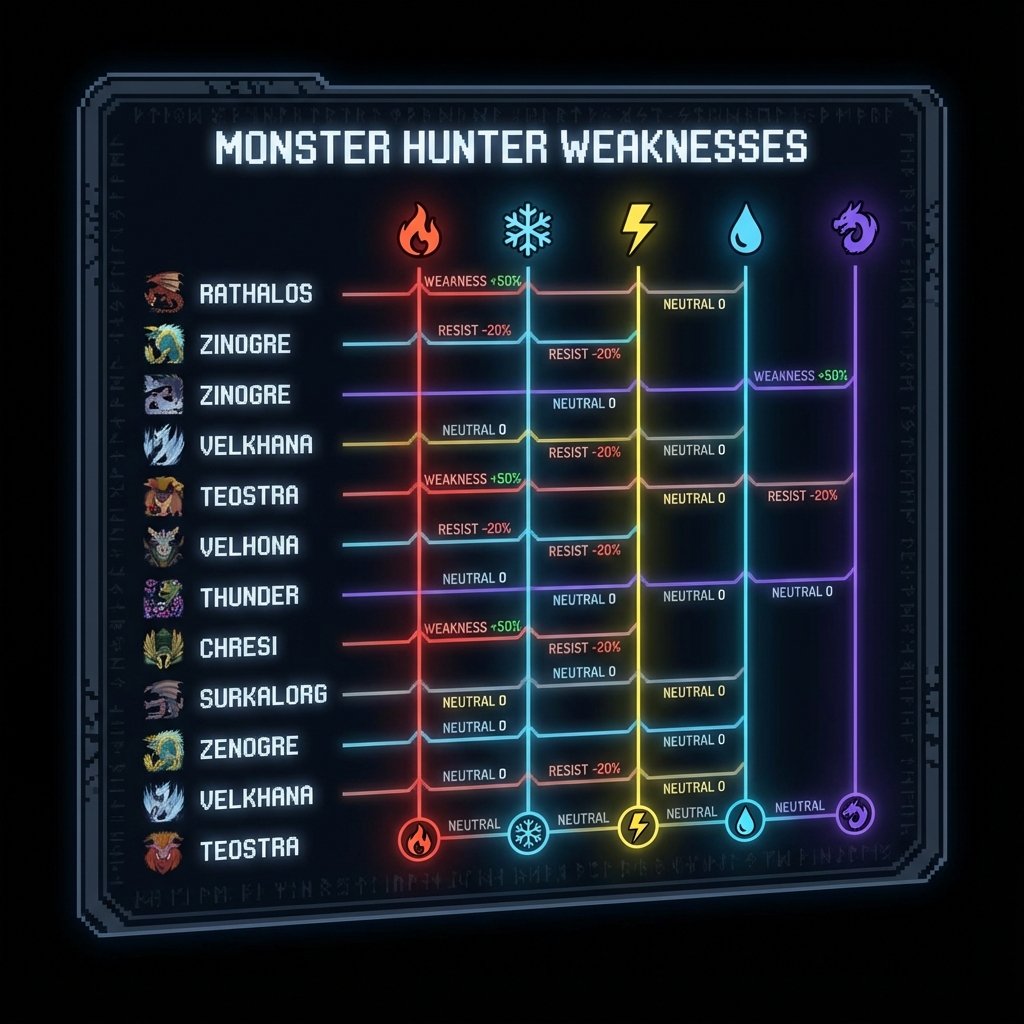
Compiled by the WildsBuilder team from extensive in-game testing and datamining. Last updated January 2026 covering all monsters through Title Update 4.
Understanding monster weaknesses is fundamental to optimizing your damage output in Monster Hunter Wilds. This comprehensive MH Wilds weakness guide covers elemental matchups, hitzone values, and status thresholds for every monster in the game.
Our team has verified all values through in-game damage testing, cross-referenced with community datamining efforts. This data forms the foundation of our Build Planner's damage calculator.
Understanding the Weakness System
Elemental Weaknesses
Every monster in Monster Hunter Wilds has varying resistances to the five elements:
| Element | Icon | Primary Targets |
|---|---|---|
| Fire 🔥 | Red | Ice-dwelling, plant-based monsters |
| Water 💧 | Blue | Fire-breathing, desert monsters |
| Thunder ⚡ | Yellow | Flying wyverns, aquatic monsters |
| Ice ❄️ | Cyan | Volcanic, tropical monsters |
| Dragon 🐉 | Purple | Elder Dragons, apex predators |
Hitzone Values
Hitzone values determine how much damage a body part takes. Values are expressed as percentages:
Monster Weakness Quick Reference
Large Monsters
| Monster | Weak Element (★★★) | Secondary (★★) | Best Hitzone |
|---|---|---|---|
| Rathalos | Dragon, Thunder | Water | Head (65) |
| Diablos | Ice | Water | Head (60), Tail (50) |
| Nergigante | Thunder | Dragon | Head (70), Horns (65) |
| Velkhana | Fire | Thunder | Head (65), Tail (50) |
| Teostra | Water | Ice | Head (55), Tail (45) |
| Kushala | Thunder | Dragon | Head (60), Wings (40) |
| Rajang | Ice | None | Head (70), Tail (55) |
Elder Dragons
Elder Dragons require special consideration due to their unique mechanics:
Key Points:
The Wound System Interaction
Wounded parts receive +20% damage from all attacks. This stacks with hitzone values:
Example: A 65 hitzone becomes effectively 78 when wounded.
Status Effect Thresholds
Understanding status thresholds helps with strategic application:
| Status | Initial Threshold | Buildup Per Hit | Decay Rate |
|---|---|---|---|
| Poison | ~180 | Varies by weapon | Moderate |
| Paralysis | ~200 | Varies by weapon | Slow |
| Sleep | ~150 | Varies by weapon | Fast |
| Stun | ~100 | Blunt weapons only | Moderate |
| Blast | ~100 | Varies by weapon | None |
Tips for Status Application
Optimizing Damage with Weakness Knowledge
Pre-Hunt Preparation
Before every hunt:
In-Hunt Targeting
Focus your attacks on:
Focus Mode Targeting
Focus Mode highlights weak points with visual indicators:
Use this information to adjust your targeting in real-time.
Conclusion
Mastering monster weaknesses transforms your hunting efficiency. Match your element, target weak hitzones, and exploit the wound system for maximum damage output.
Ready to optimize your elemental builds? Use our Build Planner to create element-specific loadouts. The damage calculator factors in monster hitzones and elemental weaknesses.
Hunt smart, hunt fast!
Our Editorial Standards
Every guide on WildsBuilder is written by experienced Monster Hunter players with verified in-game expertise. All damage values, skill interactions, and armor stats are tested directly in-game and cross-referenced with community datamining efforts. We update our guides within 48 hours of each Title Update to ensure accuracy. This article was reviewed by WildsBuilder Editorial Team, Fact Checkers.
Ready to Build?
Put this knowledge into practice with our free Monster Hunter Wilds build planner.
Open Build Planner →Levi "BladeStorm" S.
Monster Hunter Veteran • 5,000+ Hours in MH Series
Founder and Lead Build Analyst with 5,000+ hours across the Monster Hunter series. Specializes in weapon optimization, speedrun strategies, and armor set theory-crafting.